English
 中文简体
中文简体Content
Most flooring buyers assume that a carpet with a visually rich, raised pattern must be woven — a slow, expensive process that limits scale and customization. Jacquard non-woven carpet proves otherwise. By embedding intricate patterns directly into the fiber structure through computer-controlled needling technology, this category delivers the aesthetic depth of traditional woven carpet with the production efficiency and performance consistency of modern nonwoven manufacturing.
The result is a premium flooring material that has steadily expanded from niche exhibition use into mainstream residential, hospitality, and commercial applications — and for good reason.
What Makes Jacquard Non-Woven Carpet Different
Standard printed carpets apply color to the surface after the fabric is formed. This means the pattern sits on top of the fibers and is vulnerable to abrasion — heavy foot traffic eventually dulls or removes the design. Jacquard non-woven carpet works differently.
The jacquard process uses computer-controlled looms to manipulate individual fiber groups during the needling stage itself. Patterns are integrated into the fiber structure rather than applied afterward. This produces a surface with raised, tactile textures and dimensional designs that hold their appearance under extended use — the pattern is not printed on the carpet; it is the carpet.
A second distinction lies in the manufacturing process. Unlike tufted or woven carpet, which requires converting fibers into yarn before construction, non-woven carpet bonds fibers directly through mechanical needling. This eliminates intermediate processing steps, supports precise weight and density control, and allows manufacturers to engineer consistent product characteristics across large production runs.
For buyers sourcing needle-punch non-woven carpet for flooring projects, this combination of patterned aesthetics and structural manufacturing efficiency represents a meaningful upgrade over conventional printed alternatives.
Material Foundation: Why Polyester Fiber
Jacquard non-woven carpets in the premium segment are typically constructed from 100% polyester staple fibers. Polyester is a synthetic fiber produced from polyethylene terephthalate (PET) polymer, and its mechanical and chemical properties align closely with what high-traffic flooring demands.
From a structural standpoint, polyester fibers offer high tensile strength and flexibility. They bend under load rather than breaking, which translates to carpet that maintains its dimensional integrity over years of use. The fiber surface is inherently smooth and non-porous, which is why polyester carpet resists moisture absorption and prevents liquid from penetrating into the base structure.
Three performance characteristics stand out for buyers evaluating polyester jacquard non-woven carpet:
- Colorfastness and fade resistance. Polyester accepts dye at the fiber level through a process called solution dyeing or package dyeing. Once pigment is incorporated into the fiber, UV exposure and cleaning chemicals have minimal effect on color retention — a critical requirement for installations with natural light exposure or frequent maintenance cycles.
- Stain resistance. The non-porous fiber surface prevents most liquid-based stains from bonding with the material. Spills bead on the surface rather than wicking into the fiber, making cleanup straightforward.
- Wear resistance. Polyester's abrasion resistance makes it suitable for high-traffic zones — hotel corridors, exhibition halls, commercial lobbies — where flooring surfaces face constant mechanical stress.
These properties position polyester jacquard non-woven carpet as a practical choice for environments where aesthetics and durability must coexist without frequent replacement cycles.
Structure and Surface Characteristics
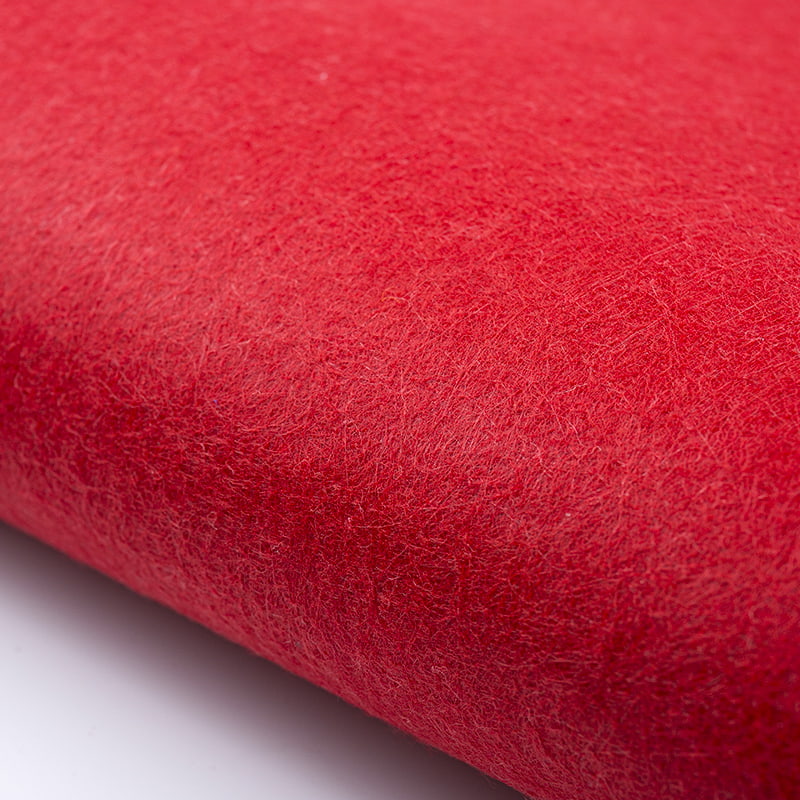
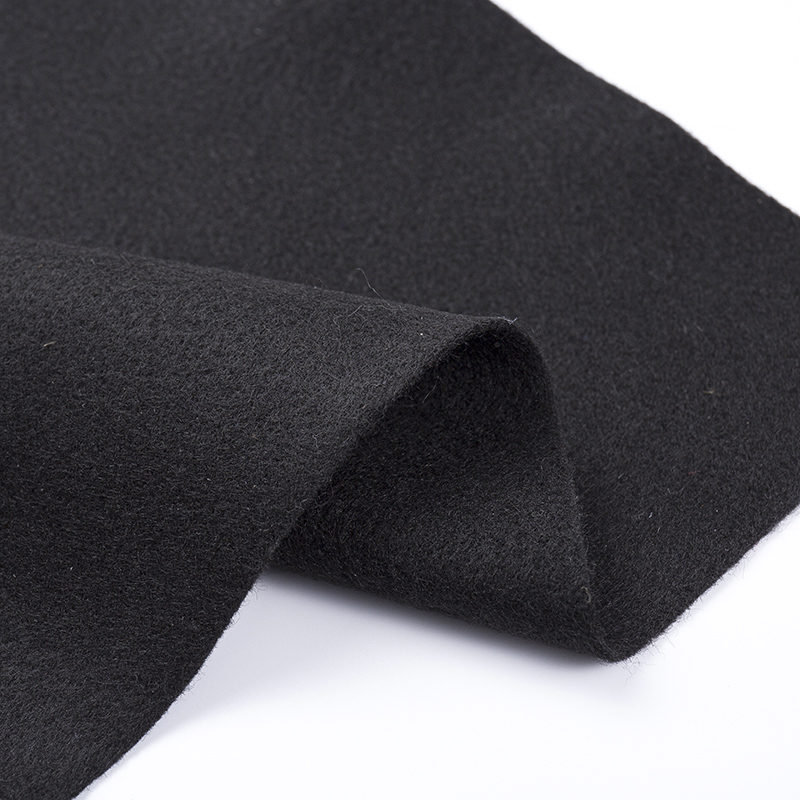
The non-woven fabric structure gives jacquard carpet its foundational stability. During needle-punch production, barbed needles mechanically entangle loose polyester fiber webs into a dense, cohesive sheet. The degree of entanglement — controlled by needle density, penetration depth, and fiber weight — determines the carpet's pile height, surface softness, and compressive strength.
For jacquard variants, the needling process is programmed to create zones of different fiber density and orientation. Denser needle penetration in certain areas compresses fibers to create recessed sections, while lighter needling leaves adjacent areas at full pile height. The contrast between these zones produces the raised pattern effect characteristic of jacquard design.
Typical specifications for commercial-grade jacquard non-woven carpet include:
| Parameter | Typical Range |
|---|---|
| Pile Weight | 350 - 600 g/m2 |
| Roll Width | 1.0 - 4.0 m |
| Backing Options | Anti-slip PVC, TPR, plain non-woven |
| Pattern Type | Single color, double color jacquard |
| Pile Height | Low to medium pile |
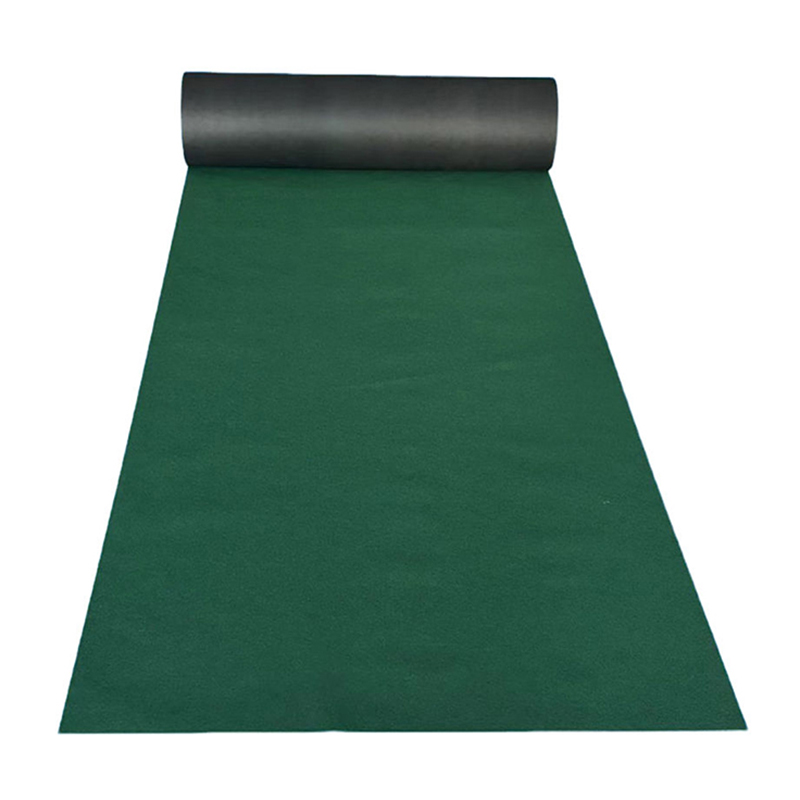
The anti-slip backing — usually PVC or TPR applied to the reverse side — anchors the carpet in place on hard floor surfaces without adhesive, an important installation feature for commercial deployments where floor reconfiguration may be required.
Performance Advantages for Real Environments
Performance claims in flooring marketing often exceed what products deliver in practice. For jacquard non-woven carpet, the durability advantages are grounded in the material science of the construction rather than surface-level marketing language.
The uniform fiber entanglement produced by needle-punching creates consistent density across the carpet surface. Unlike tufted carpet, which can develop tracking and matting in specific zones over time, needle-punch non-woven carpet distributes compressive load more evenly. High-traffic pathways show less localized wear.
Moisture resistance is similarly structural. Polyester's hydrophobic nature means the carpet surface sheds water rather than absorbing it. This prevents the sub-surface moisture retention that leads to mold and mildew growth in less engineered flooring products — a significant advantage in commercial kitchens, hospitality corridors, and other moisture-adjacent environments.
Maintenance logistics are simplified as a result. Most jacquard non-woven carpets can be vacuumed, spot-cleaned with standard commercial cleaning solutions, and maintained without specialist products or extended drying time.
For facilities managers sourcing flooring for automotive or industrial interior applications, the same structural properties — compressive resistance, moisture management, dimensional stability — translate directly into functional value in those contexts as well.
Application Environments
Jacquard non-woven carpet's combination of design capability and material durability positions it across several distinct market segments.
Residential interiors represent the broadest application base. Living rooms, bedrooms, and home offices benefit from the carpet's visual richness and ease of maintenance. The pattern variety available through jacquard programming allows homeowners to source designs that complement specific furniture styles — geometric, traditional, contemporary — without sacrificing the practical performance that polyester fiber provides.
Hospitality and commercial spaces place the highest demands on flooring material, and jacquard non-woven carpet is well-suited to those demands. Hotel lobbies, conference centers, and office reception areas require flooring that sustains its appearance through continuous foot traffic and periodic heavy cleaning. The pattern integration — built into the fiber rather than applied to the surface — holds up under those conditions in ways that printed carpet does not.
Exhibition and event venues represent a third major use case. Temporary installations require flooring that can be deployed, reconfigured, and rolled up without structural damage. Non-woven carpet's roll format, consistent construction, and anti-slip backing support rapid installation and removal cycles across repeated events.
Upholstery and decor applications also utilize jacquard non-woven fabric, particularly in automotive interiors, furniture lining, and wall paneling. The same durability and pattern fidelity that make it effective as flooring translate to these surface applications.
Manufacturers offering needle-punch nonwoven fabrics for furniture and upholstery often produce jacquard carpet within the same production framework, which enables specification flexibility across project types.
Sourcing Considerations
Buyers evaluating jacquard non-woven carpet for volume procurement should assess several factors beyond price per square meter.
Pattern repeatability and color consistency across production runs matter significantly for large installations where multiple rolls must match. Computer-controlled jacquard programming supports consistent pattern reproduction, but buyers should verify that the manufacturer's quality control processes include color tolerance testing between batches.
Pile weight and backing specification should align with the intended traffic classification. A 350 g/m2 pile weight is appropriate for light residential use; commercial installations with heavy foot traffic typically require 500 g/m2 or above for adequate durability. Backing material selection — PVC versus TPR — affects both slip resistance and the carpet's compatibility with underfloor heating systems.
Customization capabilities vary by manufacturer. Some producers offer full custom jacquard programming for bespoke patterns, logo integration, or corporate branding applications. For projects requiring distinctive design identities — hotel brand standards, retail environments, event-specific installations — this capability is worth evaluating directly with the supplier.
For buyers seeking a manufacturer with vertically integrated nonwoven production and technical carpet expertise, Huzhou Changyuan Nonwoven Co., Ltd. operates as a specialized needle-punch nonwoven fabric manufacturer in China, with product lines spanning carpet, furniture, automotive, and composite nonwoven applications.
Conclusion
Jacquard non-woven carpet occupies a well-defined position in the flooring materials landscape: it delivers the visual complexity of patterned carpet through a manufacturing process engineered for durability, consistency, and production scale. Polyester fiber construction provides the material foundation — moisture resistance, colorfastness, stain resistance, and abrasion resistance — while the jacquard needling process produces surface designs that maintain their integrity under conditions that would degrade conventional printed alternatives.
For specifiers working across residential, hospitality, and commercial contexts, it represents a category worth serious evaluation — particularly where pattern quality and long-term performance must both be delivered within practical budget parameters.
 Tel: +86 15700112297
  WhatApp: +86 15700112297
  E-mail:
  Yinziqiao Village, Shicong Town, Nanxun District, Huzhou City, Zhejiang Province, China