Industry Knowledge
How Needle-Punched Non-Woven Materials for Construction Achieve Load Distribution in Soft Soil Stabilization
When building on compressible soils such as peat, clay, or loose sand, the primary challenge is preventing differential settlement that cracks foundations and ruptures utility lines. Needle-Punched Non-Woven Materials for Construction address this by functioning as a separation and reinforcement layer between the native subgrade and the structural fill above. The mechanical entanglement of fibers during needle-punching creates a three-dimensional matrix with high in-plane tensile strength—typically ranging from 8 kN/m to 25 kN/m depending on basis weight—allowing the geotextile to bridge over soft spots and redistribute concentrated loads across a wider footprint. Huzhou Changyuan Nonwoven Co., Ltd., headquartered in Zhejiang Province with direct access to Shanghai Port, manufactures Construction Needle-Punched Nonwovens with calibrated fiber orientation ratios that optimize both machine-direction and cross-direction tensile properties. In field applications, this means a 300 g/m² needle-punched geotextile placed beneath a 300 mm granular base course can reduce subgrade stress by approximately 35% compared to an unreinforced section, extending the service life of temporary haul roads and permanent pavement structures alike.
The filtration function of a geotextile is governed by the apparent opening size (AOS) relative to the soil's characteristic particle size, but real-world performance depends on additional variables that basic specifications rarely address. Needle-Punched Nonwoven Building Material used in subsurface drainage must maintain permeability under confining stress while preventing soil piping—a failure mode where fine particles migrate through the fabric and create voids behind retaining walls or beneath road embankments. Huzhou Changyuan Nonwoven Co., Ltd. engineers its Construction Needle-Punched Nonwovens with a gradient pore structure: larger voids in the center plane provide high transmissivity for water flow, while progressively finer pores at the soil-facing surface create a stable filter cake that self-heals during cyclic wetting and drying. Laboratory testing on a 200 g/m² specification shows a permittivity of 0.5 sec⁻¹ under 200 kPa confining pressure and an AOS of 0.15 mm, making it suitable for silty sand soils with D₈₅ values between 0.1 mm and 0.3 mm. This precision matters because a filter that is too open permits soil loss, while one that is too restrictive causes hydrostatic pressure buildup that can lift road bases or destabilize slopes.
UV Resistance and Outdoor Durability Standards for Construction Needle-Punched Nonwovens
Polypropylene and polyester fibers—the primary raw materials for Needle-Punched Non-Woven Materials for Construction—degrade under ultraviolet radiation through a photochemical chain scission process that reduces tensile strength by 30–50% within six months of unprotected exposure. For Construction Needle-Punched Nonwovens that may remain exposed during staged construction or in permanent above-ground applications such as green roof drainage layers, UV stabilization is not optional. Huzhou Changyuan Nonwoven Co., Ltd. incorporates hindered amine light stabilizers (HALS) and carbon black masterbatch at 2–3% concentration during fiber extrusion, achieving ASTM D4355 retention values above 70% after 500 hours of xenon-arc exposure. The company also offers a UV-protected specification rated for 12 months of direct exposure, which is critical for infrastructure projects in high-solar-radiation climates where installation-to-cover intervals frequently exceed the 30-day standard assumed by generic geotextile datasheets. Buyers sourcing Needle-Punched Nonwoven Building Material for tropical or high-altitude projects should verify that the supplier provides batch-specific UV test reports rather than relying on generic material claims.
Comparative Performance Matrix: Needle-Punched Non-Woven Materials for Construction vs. Woven Geotextiles
Procurement teams often face a binary choice between needle-punched nonwoven and woven geotextiles, yet the optimal selection depends on the specific mechanical and hydraulic demands of the construction application. The table below provides a side-by-side comparison to guide specification decisions.
| Performance Parameter |
Needle-Punched Nonwoven |
Woven Geotextile |
Implication for Construction |
| Elongation at Break |
50–80% |
15–30% |
Nonwovens accommodate ground movement without tearing; wovens require stable subgrades |
| Pore Size Distribution |
Graduated, three-dimensional |
Uniform, two-dimensional |
Nonwovens self-filter across soil particle ranges; wovens risk blinding in fine soils |
| Puncture Resistance |
High (fiber entanglement absorbs point loads) |
Moderate (warp/weft threads deflect) |
Nonwovens withstand angular aggregate contact during placement |
| Cost per Square Meter (equivalent strength) |
15–25% lower |
Baseline |
Nonwovens offer cost efficiency for separation and filtration-dominant applications |
| Installation Handling |
Flexible, conforms to irregular surfaces |
Stiff, requires tensioning equipment |
Nonwovens reduce labor time and specialized equipment needs |
Huzhou Changyuan Nonwoven Co., Ltd. produces both Needle-Punched Non-Woven Materials for Construction and woven alternatives from its Zhejiang facility, allowing engineers to select the most cost-effective specification for each project phase rather than defaulting to a single material type across an entire build.
Recycled Content Integration in Construction Needle-Punched Nonwovens Without Compromising Geotechnical Performance
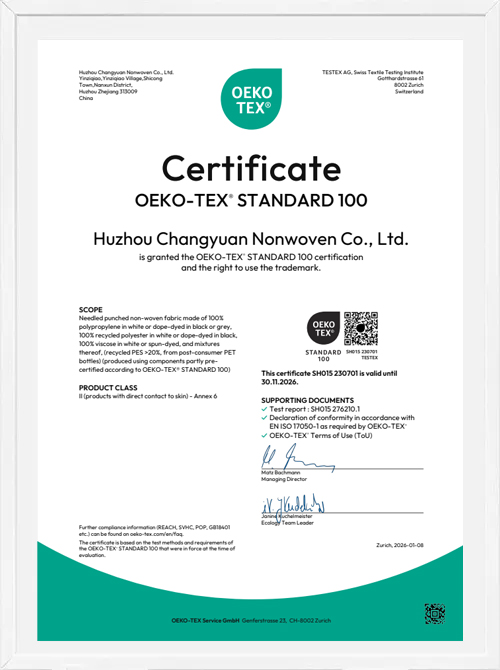
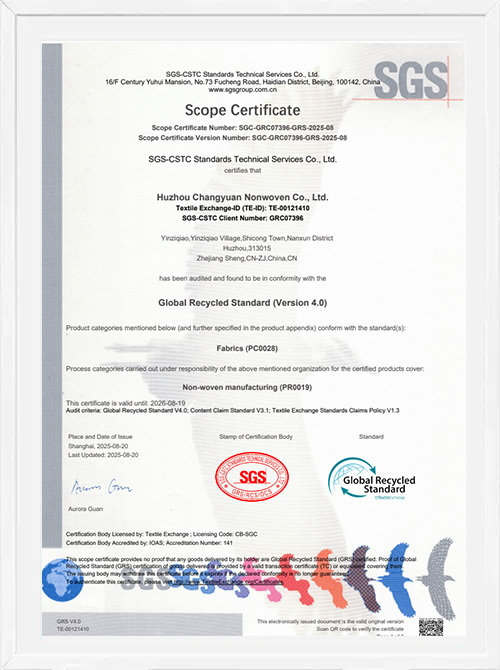
Sustainability mandates in public infrastructure procurement—particularly in the European Union and increasingly in Southeast Asia—require construction materials to incorporate verified recycled content. The technical challenge with Construction Needle-Punched Nonwovens is that post-consumer recycled polypropylene exhibits broader molecular weight distribution and higher ash content than virgin resin, which can reduce fiber tenacity and increase breakage rates during needle-punching. Huzhou Changyuan Nonwoven Co., Ltd. addresses this through a controlled blending protocol: recycled PP flakes are melt-filtered through 325-mesh screens to remove contaminants, then compounded with virgin PP at ratios that maintain the 3.5–4.5 g/denier tenacity threshold required for geotextile applications. The company's GRS certification verifies that its Needle-Punched Nonwoven Building Material product line contains up to 50% post-consumer recycled content while still meeting EN 13249 tensile strength and EN ISO 12956 filtration efficiency standards. For contractors bidding on green building projects, this dual compliance—sustainability certification plus full geotechnical performance—eliminates the trade-off between environmental credentials and engineering reliability that has historically slowed recycled geotextile adoption.
Installation Protocols That Maximize the Service Life of Needle-Punched Non-Woven Materials for Construction
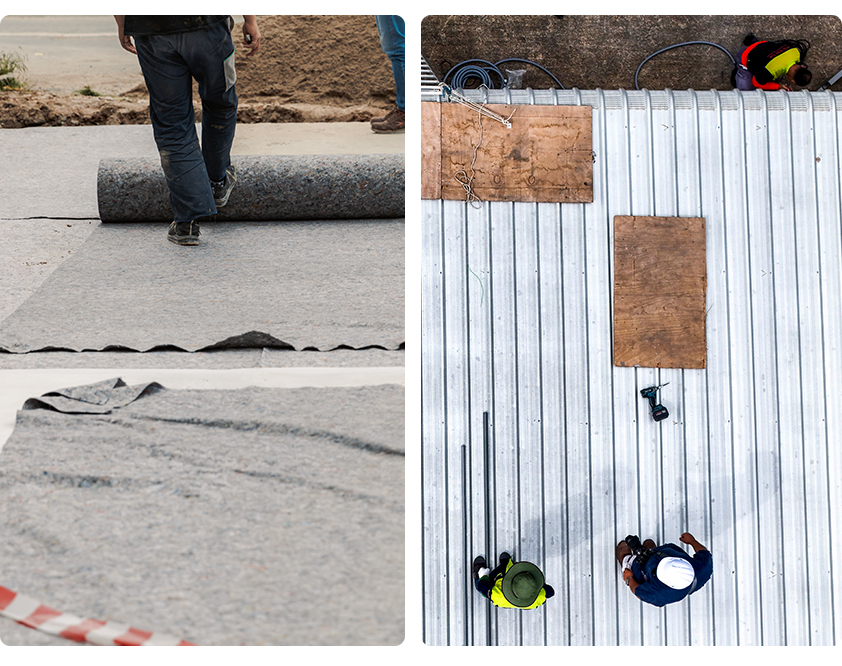
Even the highest-quality Needle-Punched Non-Woven Materials for Construction will underperform if installation practices create wrinkles, overlaps with insufficient overlap width, or exposure to construction equipment damage. Huzhou Changyuan Nonwoven Co., Ltd. provides project-specific installation guidelines based on its geotextile specifications, with the following critical control points:
- Subgrade preparation: The native soil must be graded to within ±50 mm of design elevation and cleared of protruding stones or organic debris that could puncture the Construction Needle-Punched Nonwovens during placement. For rocky subgrades, a 100 mm sand bedding layer is mandatory before geotextile deployment.
- Overlap requirements: Longitudinal seams between adjacent rolls require a minimum 300 mm overlap for slopes less than 10° and 500 mm for steeper inclines. Transverse overlaps at roll ends must be 500 mm minimum. These dimensions account for thermal contraction during nighttime temperature drops, which can pull loosely overlapped seams apart.
- Cover placement speed: The protective fill layer above the Needle-Punched Nonwoven Building Material must be placed within 48 hours of geotextile deployment to prevent UV degradation and wind uplift. Dump trucks should not drive directly on the exposed geotextile; instead, a minimum 150 mm of cover material must be spread ahead of vehicle traffic.
- Tensioning control: Unlike woven geotextiles, needle-punched nonwovens should not be tensioned during placement. The fabric should be laid loosely with minimal wrinkles—excessive tension reduces the elongation capacity that allows the material to conform to settlement-induced deformations.
These protocols, combined with the logistical advantage of Shanghai Port proximity for rapid material delivery, ensure that Huzhou Changyuan Nonwoven Co., Ltd. customers receive both the product and the technical support needed for durable installation outcomes.
Chemical Resistance Profiles of Needle-Punched Nonwoven Building Material in Aggressive Soil Environments
Construction sites frequently encounter soils with pH extremes, high sulfate concentrations, or hydrocarbon contamination that can degrade geotextile polymers over decades of service. Polypropylene-based Needle-Punched Nonwoven Building Material exhibits excellent resistance to acids and alkalis across the pH 2–12 range, making it suitable for mining tailings containment, acid sulfate soil regions, and coastal environments where salt crystallization cycles stress the fabric matrix. Polyester-based Construction Needle-Punched Nonwovens, by contrast, are vulnerable to alkaline hydrolysis in environments with pH above 9.5—such as cement-stabilized subgrades or lime-treated soils—where ester bonds in the polymer chain break down over time. Huzhou Changyuan Nonwoven Co., Ltd. offers material selection guidance based on site-specific chemical analysis, ensuring that Needle-Punched Non-Woven Materials for Construction are specified with the correct polymer chemistry for the intended service environment. For sites with unknown contamination, the company can provide accelerated aging test data from immersion in simulated soil solutions, giving engineers confidence in 50–100 year design life projections.
Supply Chain Efficiency: How Shanghai Port Proximity Reduces Lead Times for Bulk Construction Needle-Punched Nonwovens
Large-scale infrastructure projects operate on tight schedules where geotextile delivery delays can cascade into critical path disruptions for earthworks and pavement placement. Huzhou Changyuan Nonwoven Co., Ltd. leverages its Zhejiang location—approximately two hours by truck from Shanghai Port—to offer supply chain configurations that inland manufacturers cannot match. For a typical 40-foot container shipment of Needle-Punched Non-Woven Materials for Construction bound for Southeast Asia, the total transit time from factory gate to port loading is 3–4 days, compared to 10–14 days for suppliers in Henan or Shandong provinces. This proximity also enables flexible order sizing: rather than committing to full container loads months in advance, buyers can arrange consolidated LCL shipments with weekly sailing frequencies, reducing inventory holding costs and allowing just-in-time delivery that aligns with phased construction schedules. For Construction Needle-Punched Nonwovens used in emergency repair projects—such as levee reinforcement after flood damage or road reconstruction after landslides—the ability to move material from production to vessel within 72 hours can be the difference between meeting and missing a weather window for construction.


 English
 中文简体
中文简体 Furniture
 Carpet
 Automotive
 Composite
 Geosynthetics
 Medical
 Filtration
 Cleaning Supplies
 Building Industry
 Agricultural Use
 Consumer Goods

 Compliant with Environmental Standards
  Tear-resistant and Durable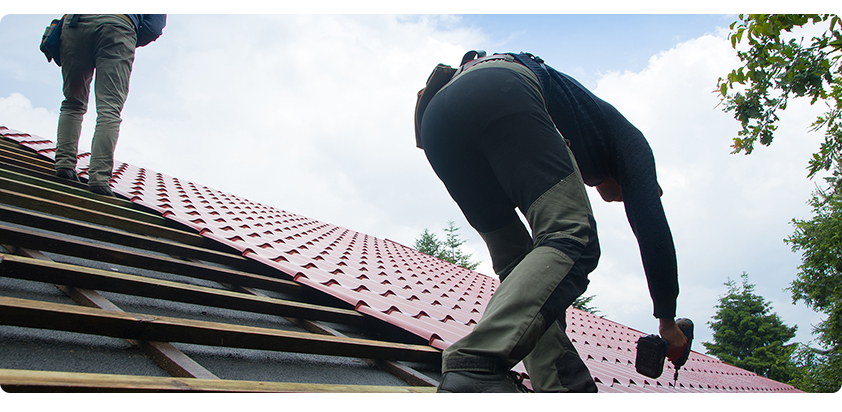
 Tel: +86 15700112297
  WhatApp: +86 15700112297
  E-mail:
  Yinziqiao Village, Shicong Town, Nanxun District, Huzhou City, Zhejiang Province, China